
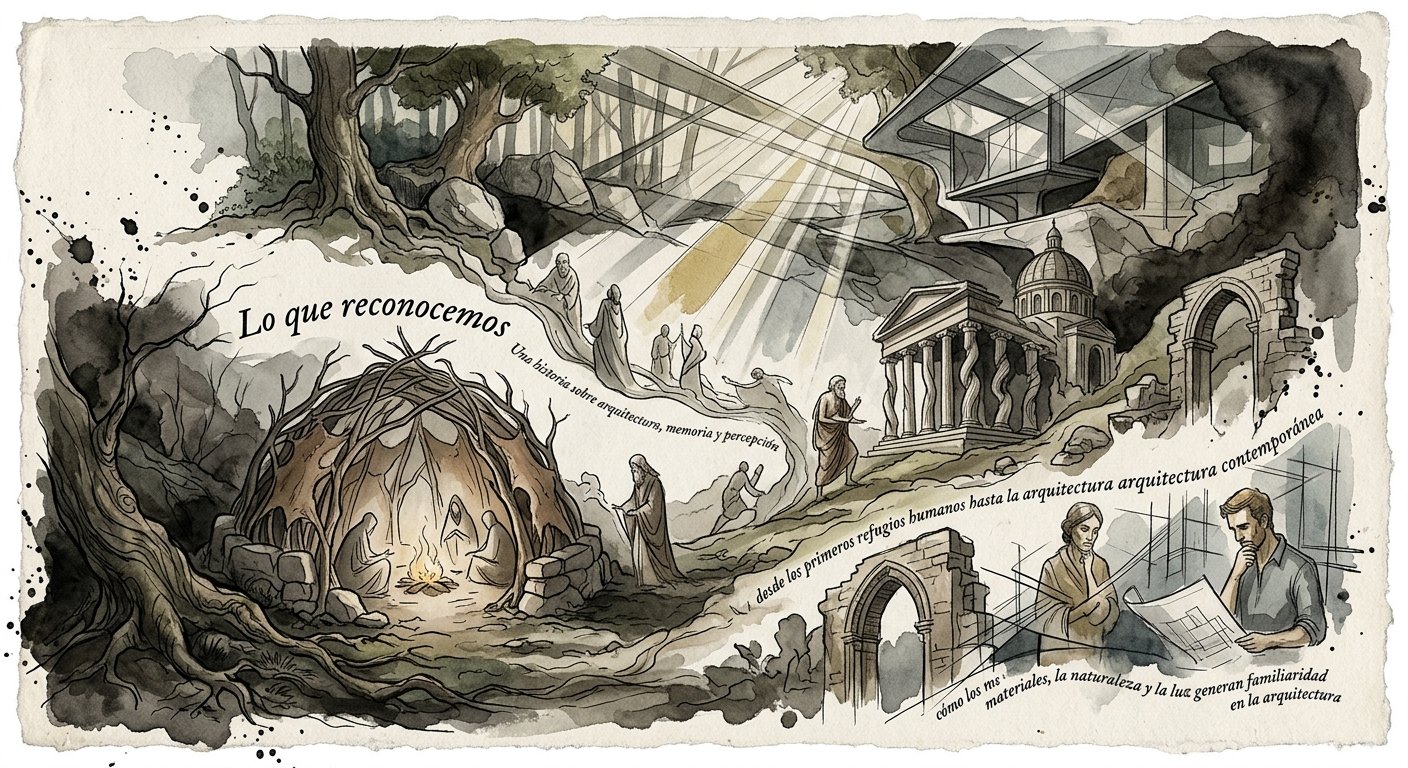
A story about architecture, memory, and perception
The Architecture We Don't See
What Explains Itself
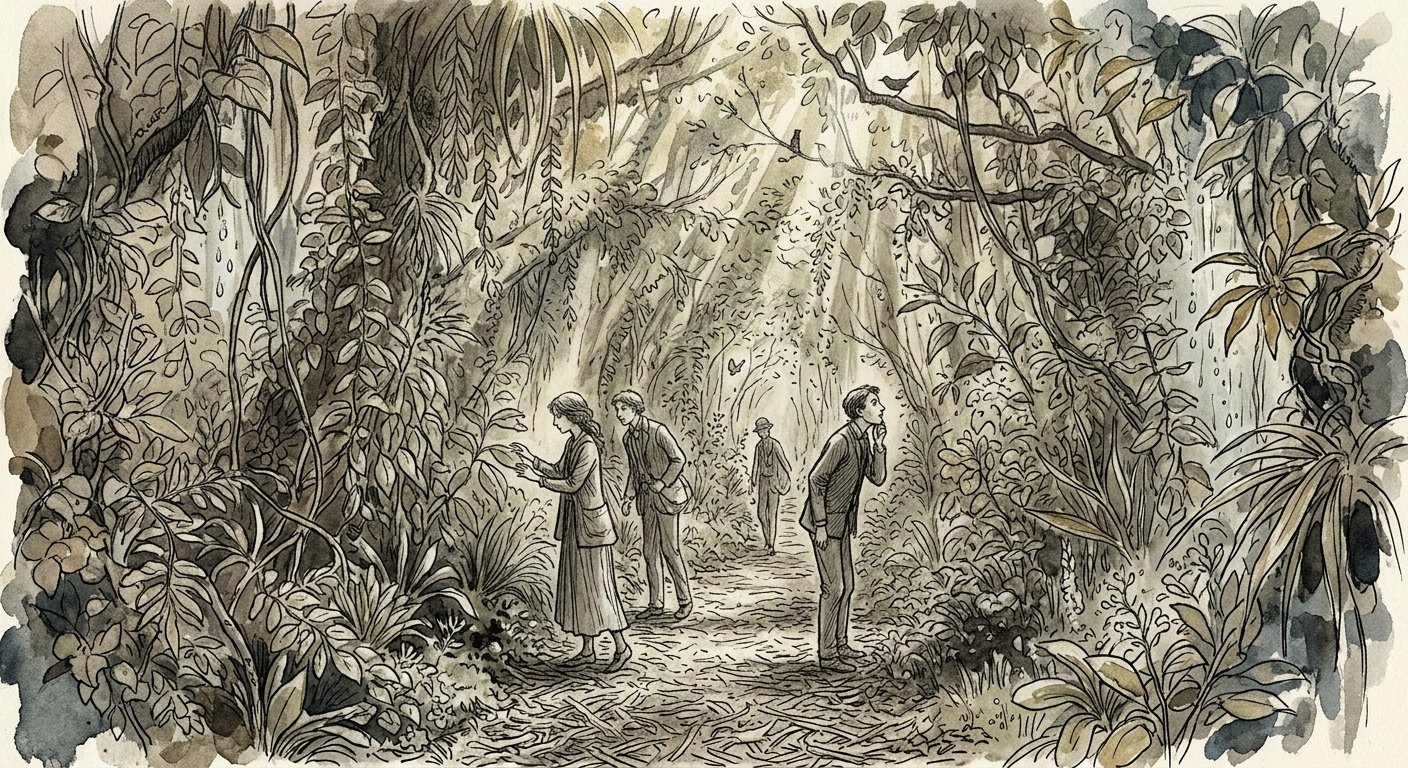
The place was filled with plants that hung down, climbed, and enveloped a path. The vegetation seemed to spill beyond its surroundings. It was as if an excited audience were waiting for celebrities about to step onto a stage. But they had a very different sound from human crowds. Instead, there was the murmur of water and the song of birds, immersing everything in nature. Rays of light filtered through the treetops, resembling a shower of sunlight. The path through this place was covered with a carpet of shredded wood that produced a pleasant tactile sensation underfoot. A small group of visitors moved along the trail. They were not walking absentmindedly, but completely absorbed. They observed everything. More than observing, they seemed to feel the space with their whole bodies.
And although I was enjoying the place as well, their reaction caught my attention. The garden captivated them in a very particular way: they did not simply walk through it, but stopped at every turn to celebrate its beauty aloud. And, true to the habits of our times, cameras kept clicking to immortalize the moment on social media.
The Mediation
That garden explained itself through the senses; there, nature was the attraction. In contrast to this experience, I once visited a highly acclaimed building. Through his words, a guide revealed its hidden layers to us. His stories completely captured our attention. He was one of those people with a gift for conveying what lies behind things, making visible, and even beautiful, what had previously gone unnoticed.
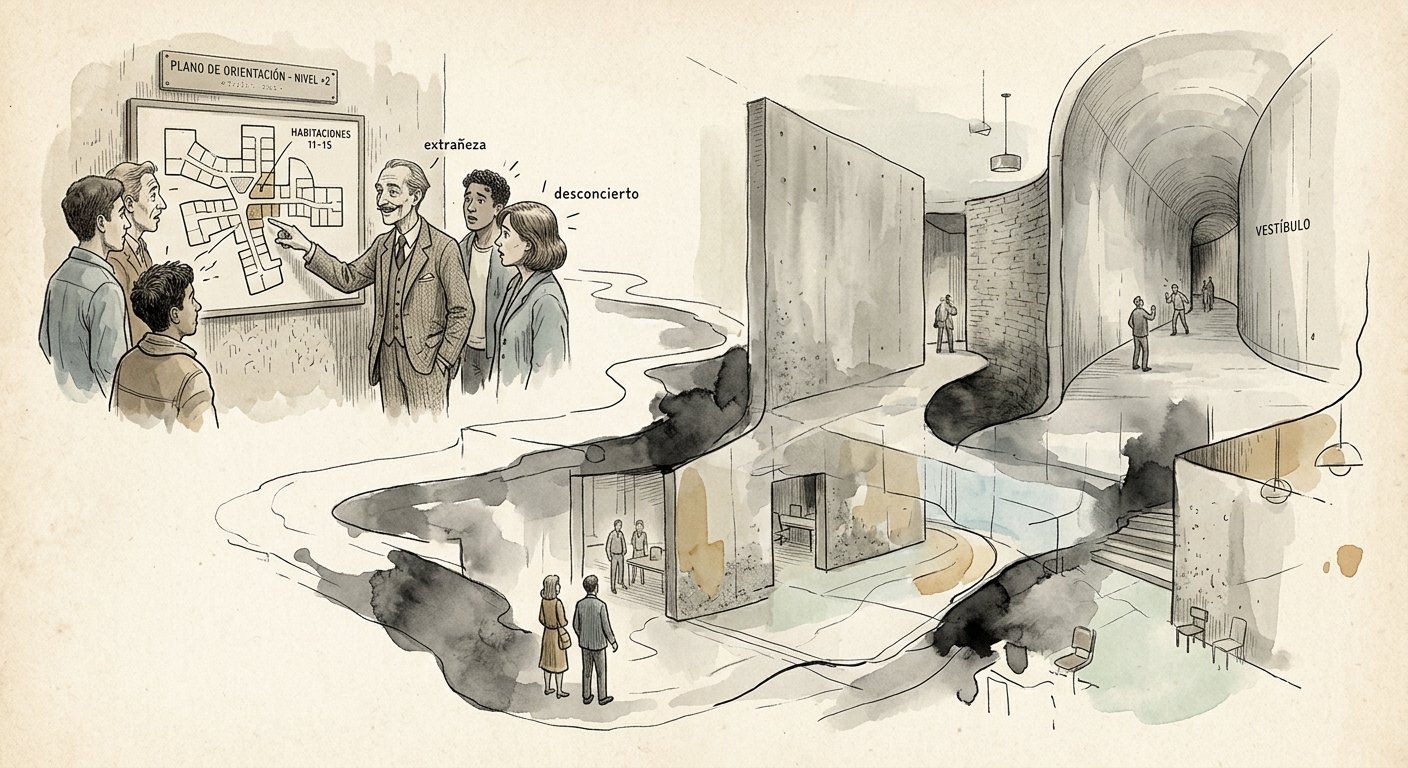
The tour began before we had a chance to stop and look at the building. The guide stopped in front of the orientation map in the lobby. He pointed to some rooms that seemed to be out of place. Our bewilderment grew when he described the route we would have to take to reach them. Seeing our puzzled faces, he smiled. He let us study the map for a few moments, until someone admitted that they did not understand the route. Only then did we realize that the arrangement of the spaces broke with the usual layout. And although we had yet to experience it, the idea surprised us.
We moved deeper into the building. We walked alongside tall, uninterrupted walls that made it difficult to tell where one room ended and the next began. Someone remarked that the lobby seemed endless, bringing the group to a halt. When we looked back, we understood what had happened: we were standing in a completely different space without having crossed a single door. No one had noticed how the spaces had merged into one another. Only after hearing the guide's explanation did expressions of surprise begin to appear.
Soon afterward he led us to balconies that, instead of looking out onto the landscape, opened toward the very heart of the building. Paradoxically, the rooms they came from seemed to float outside. It was as though the traditional categories that separate interior space from exterior space had blurred. To some, it made no sense. Others looked around, trying to understand its logic. Little by little, expressions of bewilderment gave way to a curiosity that was difficult to conceal.
The group continued along the tour without stopping for long anywhere. The guide was the one who decided when a place was worth lingering in. At one point we left the usual route. We reached a place where the beams and supports were completely exposed, as if the building had revealed its skeleton. No one seemed to understand why we were there until the guide told us an extraordinary story: the trials and difficulties the architects and engineers had faced to make the building stand. In the process, they had pushed the limits of what was possible. Only after hearing that story did questions rain down on him with genuine interest.
The tour ended on an outdoor plaza. From there, for the first time, the entire building appeared before us. Some, apparently tired, were about to leave; but before they could, the guide revealed one more thing: the sophisticated geometric play of the façade. Each figure seemed to be contained within another. Without his voice, that visual artifice would have passed as just another façade. In the end, as in the garden, dozens of photographs immortalized the moment.
As we left the building, I could not get one thought out of my head. I had no doubt that I was standing before an extraordinary work. Behind it lay an enormous effort, technical decisions of evident complexity, and, of course, a multimillion-dollar investment. But a question came over me: Without the constant mediation of a guide, would anyone have seen the genius behind those walls? What made such a difference compared with that garden?
What We Pursue
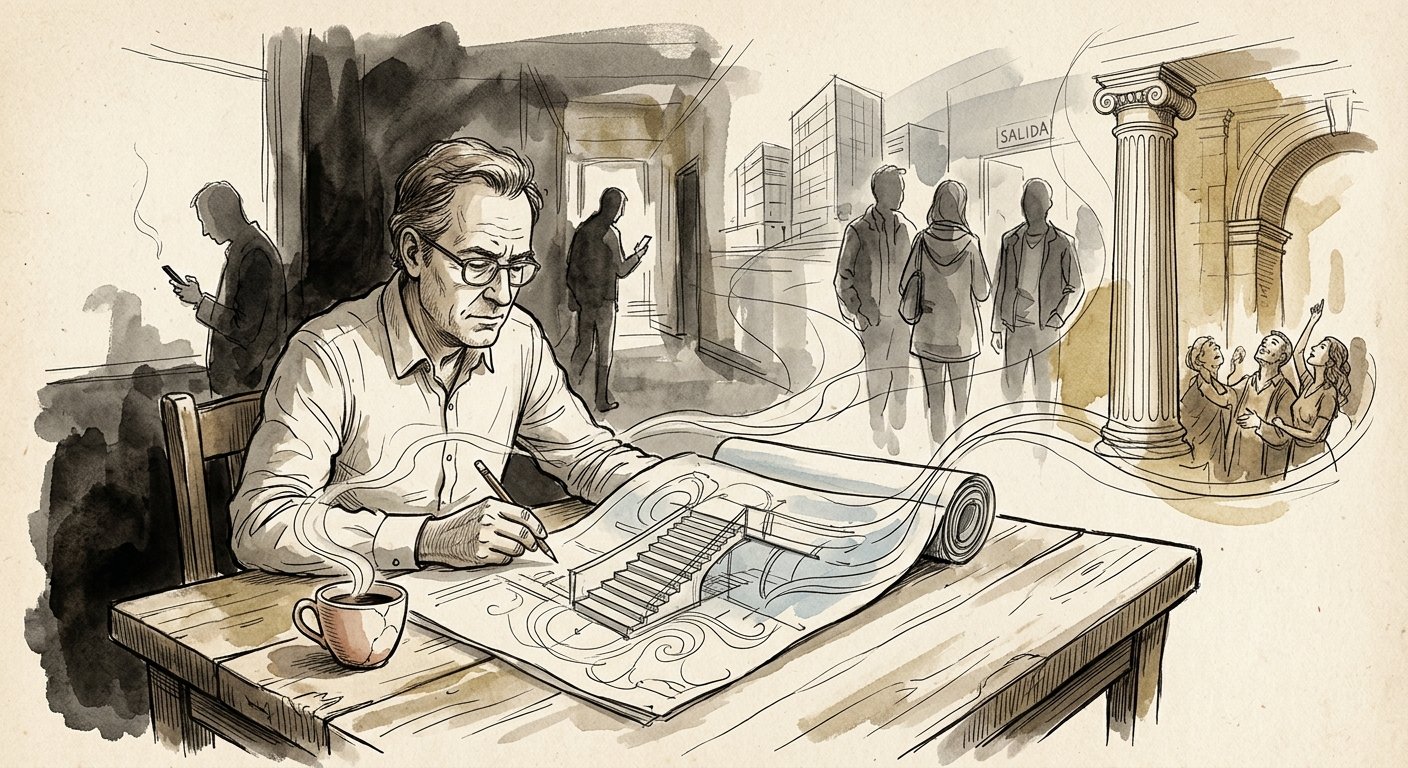
The next day, while reviewing some drawings, I found myself thinking again about the visit to the building. Little by little, a scene I had experienced before came back to me. I remembered other buildings that architects admire and, with them, the same image: while I remained absorbed, trying to understand them, everyone else was simply looking for the exit or checking their phones. The scene had repeated itself so many times that I began to wonder whether that admiration was really as spontaneous as we assumed.
Then I thought about how we learn to recognize certain buildings as references. From architecture school onward, we encounter them in books and magazines, study them in class, listen to teachers and critics interpret them, and come across them again and again as examples of good architecture. Without realizing it, we also learn what we are supposed to look at and what we are supposed to admire.
As I looked at the drawings of a wooden staircase, I thought about old buildings. I realized that this experience did not happen with every building. . In front of cathedrals, ancient temples, or exuberant palaces, the scene is usually different: there, the emotion seems collective and spontaneous. No one needs to explain to us why we are standing before something extraordinary.
The question began to take shape as I drank my cup of coffee: does what architects have pursued for at least the last hundred years really move anyone outside our profession? Shouldn't a building move us before it explains itself?
Before Us
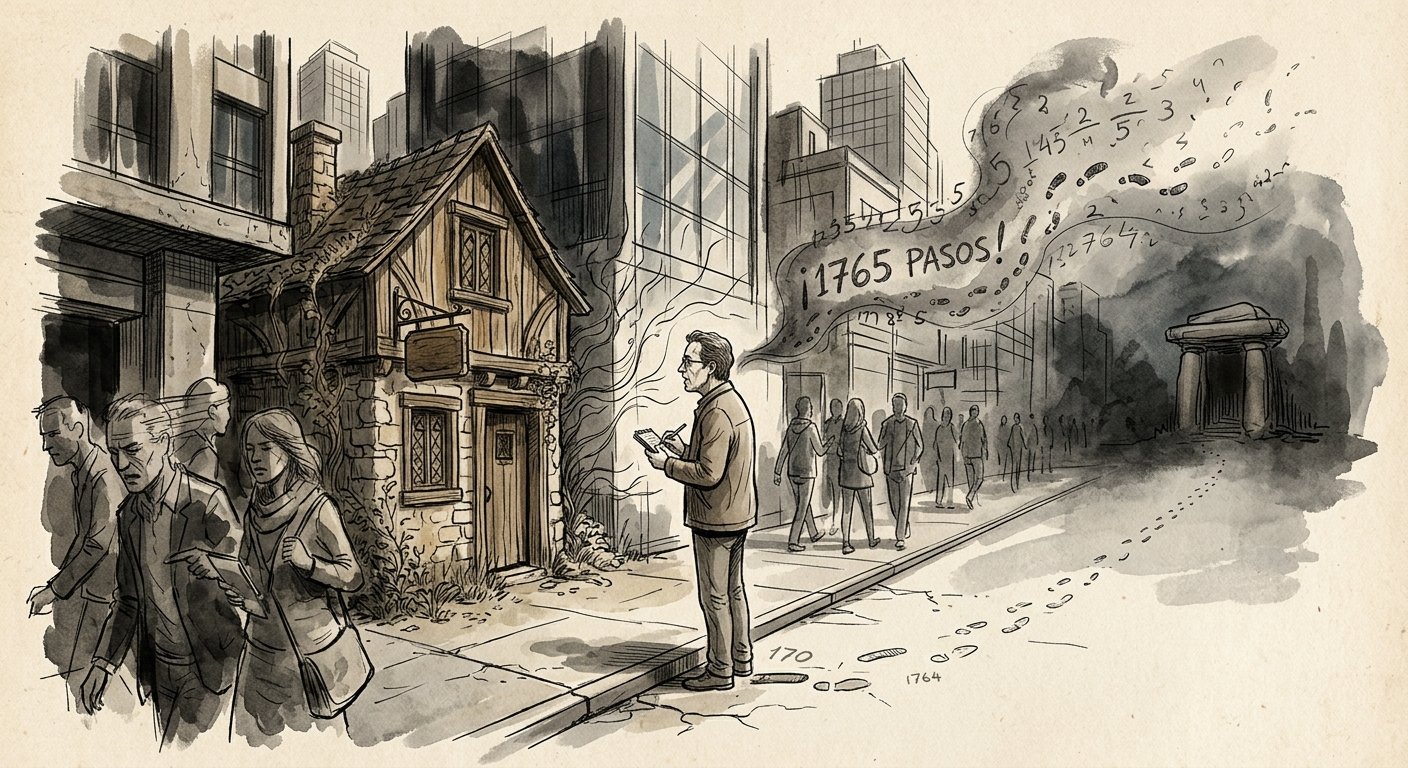
Some time ago I went out for a walk. The street was like so many others in countless cities: sidewalks, concrete buildings, asphalt streets, and people in a hurry to reach their destinations. I had been turning over an idea that had a lot to do with that setting: these urban spaces, which we are so accustomed to, can sometimes feel completely foreign to us. As I passed an old surviving building made of stone and wood, a question came to mind: how long, as a species, have we been living in these urban environments of concrete, glass, and steel? If the figures I remembered were correct, the transformation had begun only 170 years agoAfter answering myself, I stopped. Three seconds later I took a step forward. I stopped again. This irritated the passersby, who had to walk around me. Without worrying too much, I thought: if this step represents the time our species has lived in modern environments, how many steps did we take before that? It took me longer to answer this second question. I strained my memory, did the calculation in my head, and exclaimed aloud: 1,765 steps!
A House in the World
Ignoring the elbows I was bound to receive, I decided to take a few steps backward. I wanted to see how far 1,765 steps really were. As I did, something extraordinary happened: a kind of acceleration of time, which I could see slipping past me on either side. Vertigo shook me, and by the fifth step I stopped abruptly; but the asphalt and the noise of the city had already dissolved, giving way to a completely unfamiliar place. At that moment I did not know it, but I had been transported 850 years into the past.
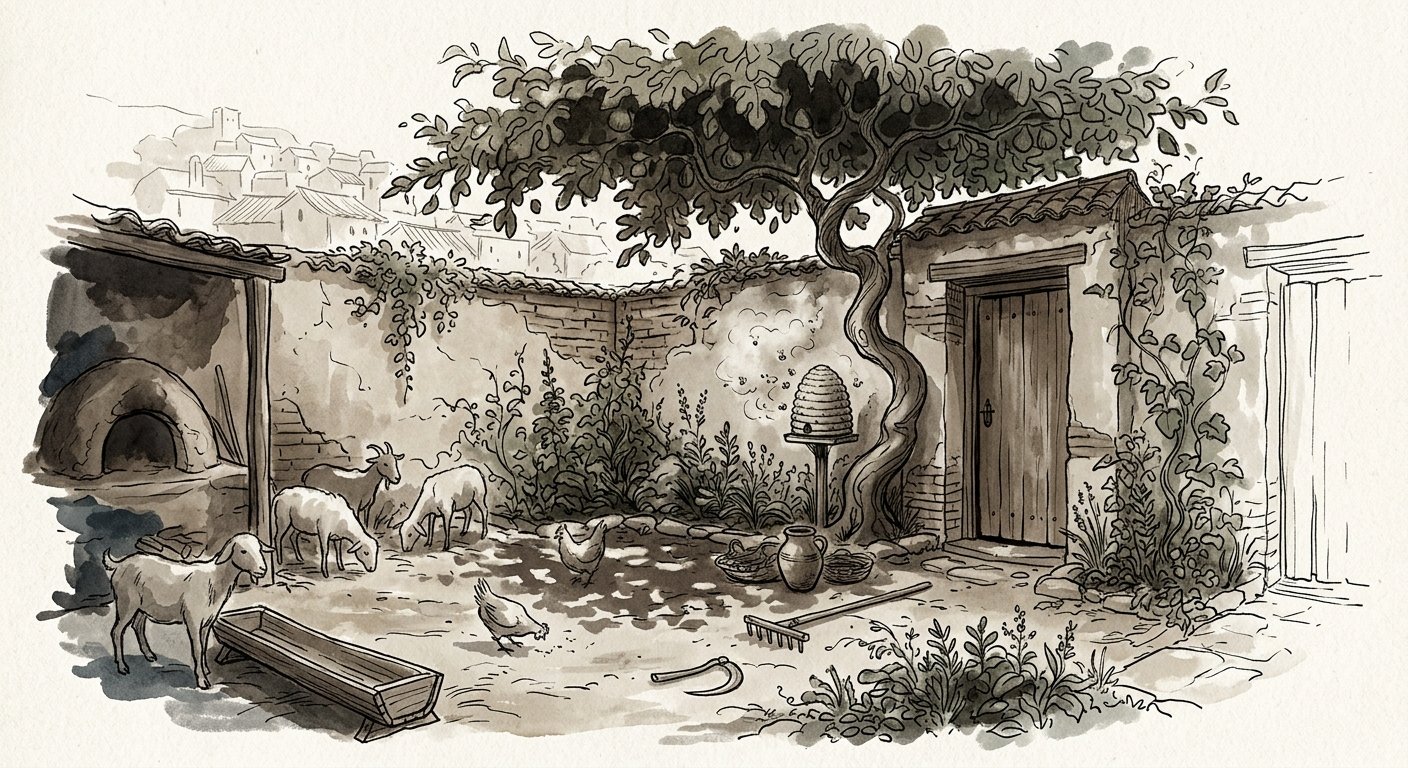
Little by little, my fright gave way to curiosity. Looking around, I discovered a small village a short distance away. I headed toward it and, as I approached, estimated that it had between thirty and forty houses. When I entered the village, I could make out very few people. It was midday, and most of the population was busy with some kind of agricultural activity outside the village. I decided to enter a house on the outskirts that appeared to be empty. The entrance led me into a courtyard. At the edge of the courtyard stood what appeared to be the only enclosed room in the house. In the courtyard I found several utensils, work tools, and a bread oven. But what caught my attention most was the way nature seemed to seep into this private world. There were vegetables, medicinal plants, and other edible plants, some growing right alongside the walls. A group of fig trees seemed to occupy a privileged position, casting a pleasant shade over the space. Sheep, goats, chickens, and even a group of bees clustered around a hive inhabited the courtyard.
Just then, a woman passed very close to the house carrying water. I later learned that she had come from a well on the outskirts. Afraid she might see me, I slipped into the room. The space was somewhat dark, allowing only a few rays of sunlight through a couple of half-open windows. At first I could make out nothing, but as my eyes adjusted I began to see the room. Bunches of garlic and onions and some cooking herbs hung from the ceiling beams. Bundles of wheat were stored in one corner. On the packed-earth floor, a group of newborn chicks huddled together in another corner. There was not much furniture: a few chairs, a table, and some rolled-up mats. At that moment I saw a cat dart past, chasing a mouse. I leaned toward the window overlooking the street to see whether I could get out without being noticed. Once I was sure I could, I quickly made my way back through the courtyard.
Back on the street, I decided to explore the few dirt paths that connected the houses while also separating them. In front of one house I saw some dogs sleeping beneath an eave. A few houses farther on, I came across a boy herding a group of goats. At the opposite edge of the settlement, an old man was concentrating on carving what appeared to be a wooden tool. The paths were more an extension of the surrounding wilderness than what comes to mind today when we think of a street. Grass grew freely along their edges and beneath the trees that lined them. At one point, a fairly large group of birds flew out of a large tree and began circling over the village. When they disappeared, I noticed something I had not paid attention to before. The village was very quiet. I could hear the hum of insects, the rustling of leaves, the sound of some domestic animal, and, in the distance, the murmur of running water. After walking through it for some time, I realized that the village dissolved into the landscape around it.
When the World Disappeared
After walking through the village, I thought it would be best to find a way back; however, my curiosity to learn more about its inhabitants made me change my mind. I decided to wait for those who had gone out to return. Just as I had imagined, they came back shortly before sunset. As if celebrating their arrival, sunset followed: a true visual spectacle. As the horizon began to blaze, countless birds, accompanied by other animals, joined in a musical concert announcing the end of the day. But what impressed me most came afterward.
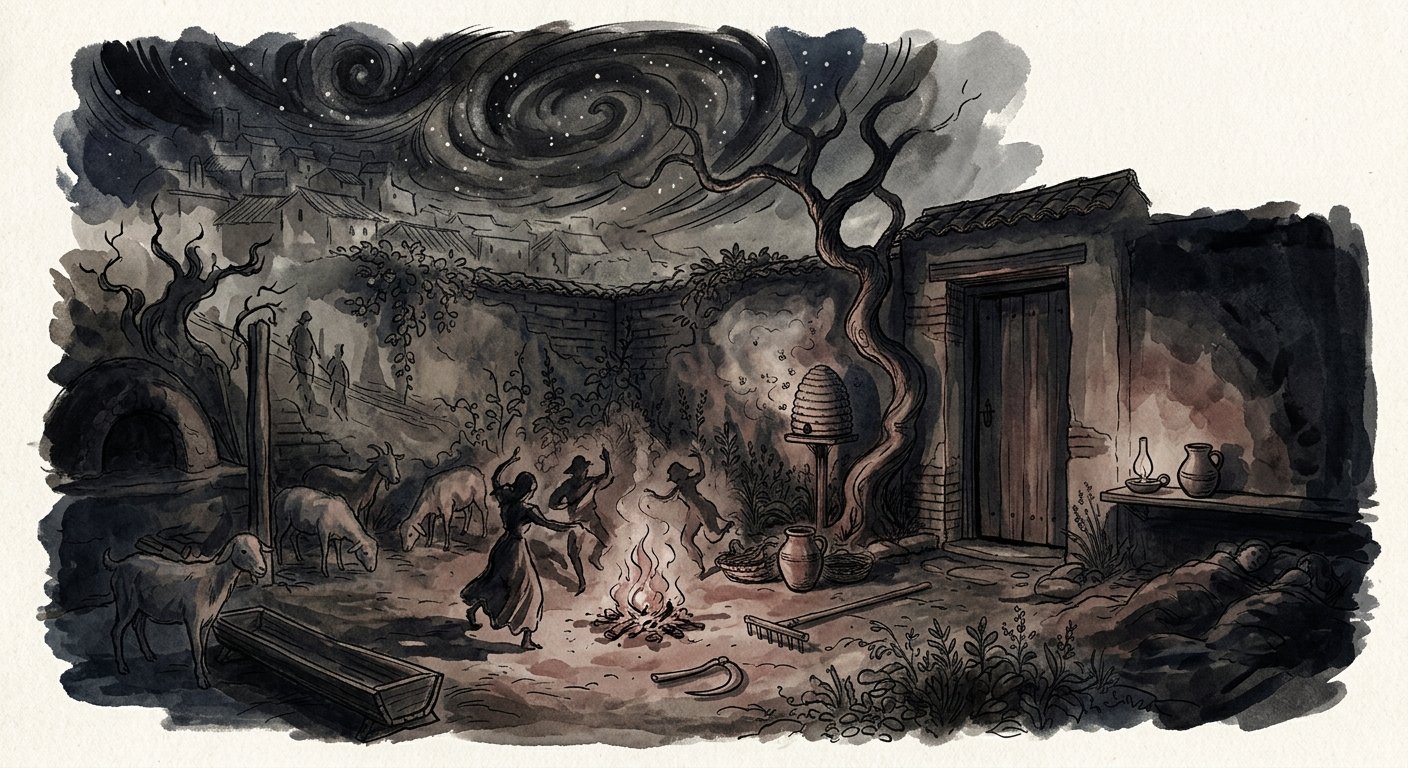
As the sun disappeared, activity came to a halt. A kind of curfew seemed to take hold of the place. Little by little, conversations ended, animals settled into their places, and people withdrew. Throughout this transformation I did nothing but watch, trying to take it in. Only a few minutes earlier I could make out the houses, the animals, and the people returning from the fields. Now those same places, along with their sounds, disappeared into the darkness. Until the moment came when all I could see was a sky crowded with stars. I had never had the feeling that the celestial vault occupied so much space. There was no moon that night. Just minutes before I could see absolutely nothing, I came out of my daze and found shelter in one of the houses.
Crossing the threshold of this domestic space felt like leaving the territory of the unknown behind. In its courtyard, the flickering fire tried, with little success, to drive back the depth of the darkness. All that could be seen were figures dancing to the rhythm of the fire's scarlet glow. After a while I began to adjust to the dimness. As I did, I wanted to see my surroundings. On a shelf I discovered a small oil lamp. It remained unlit. The gathering around the fire did not last long. Soon afterward they extinguished it, deepening the darkness and silence even further. In complete darkness we entered the only room to sleep. Lying down, I thought that, with such fatigue, sleep would come quickly. But it did not. The density of the darkness kept me from relaxing. I was surprised to discover that the nighttime silence allowed me to hear sounds that seemed to come from places very far away. I do not know how long I remained awake; it could have been hours, although memory becomes hazy. What I remember clearly is the moment I woke: the activity of my hosts was once again filling the air. It happened just before dawn.
When I stepped into the courtyard, I could see how the distant light beginning to appear in the sky gradually returned shapes to the earth. First I could make out the silhouettes of the trees and houses. Then the objects in the courtyard appeared, and finally the faces of those who were already beginning to move. The world made sense again. As this happened, I wanted to see what the room where I had spent the night was like. The first rays of sunlight filtered through the window shutters. More than the room itself, what captured my attention was what the sunlight, which seemed to have discovered it for the first time, created within that small space. After a single night in total darkness, I appreciated everything the sun brought with it: life, warmth, and a thousand variations of tone and intensity. It is something we may have forgotten after spending so much time indoors.
To Stay
With daylight restored, I headed toward the place where I had taken those steps. Along the way I thought about the village, its few inhabitants, and the house where I had spent the night. Later, after doing a little research, I discovered that its size was nothing unusual. For several centuries, practically all of humanity lived in settlements like that one, and even smaller ones. After having lived in that house, I wondered when we had first begun building houses. Just before beginning the return to my present, my curiosity about other ways of life once again made me change my mind. This time I wanted to take the journey much farther back. By then I knew how the displacement worked, so I calculated seventy-eight steps backward to reach a time I imagined to be very distant. I did so and, once again, found myself displaced into another time. According to my calculations, I was now 14,000 years away from my present.
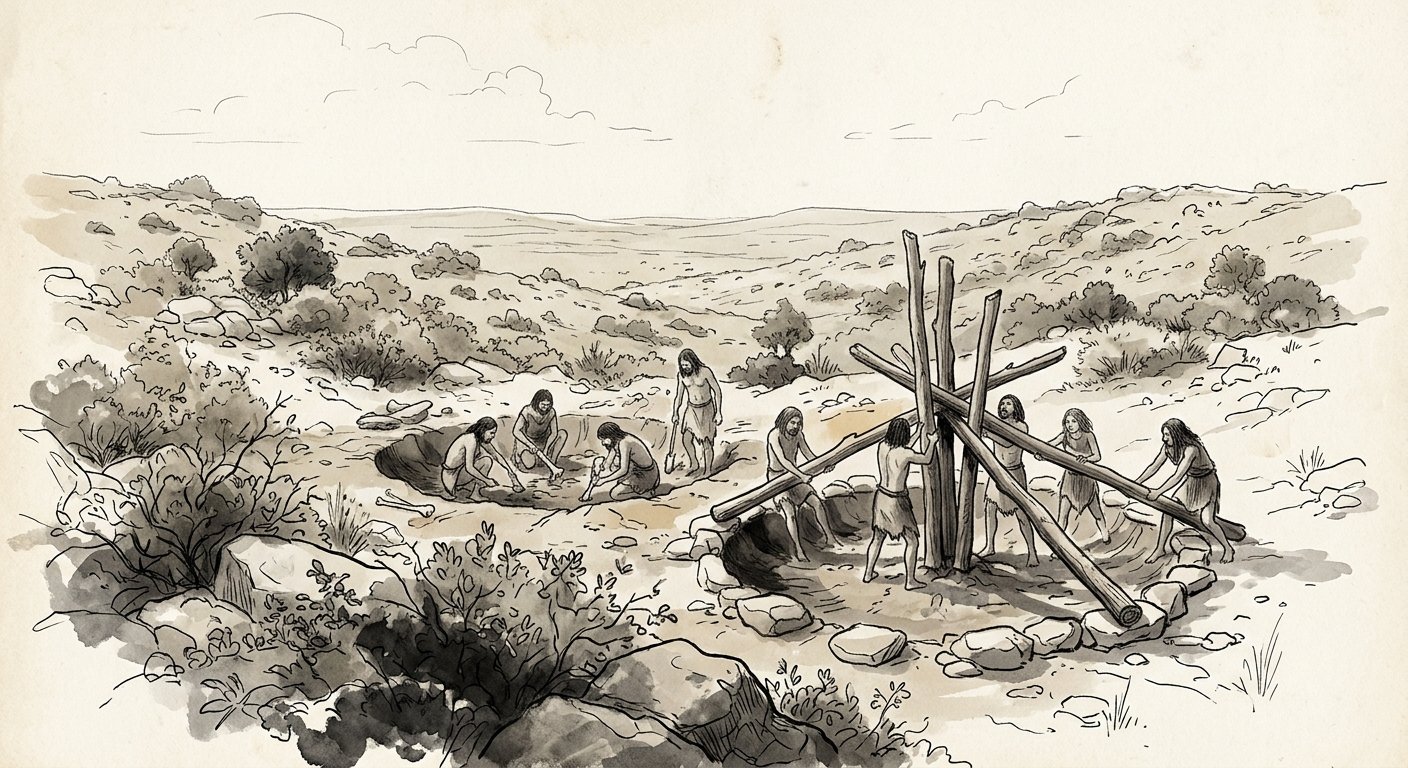
The place where I arrived was a fertile valley, covered with wild shrubs, pistachio trees, and scattered oaks beneath an immense sky. The slopes stretched open in every direction. There were no buildings or paths; only vegetation covering the ground and, among it, the irregular shapes of stones. I walked for a while, fortunately not too long, until I found what I was looking for. I positioned myself where I could see without being seen. A group of Homo sapiens was building two structures. In one of them, they were working on a more or less circular excavation. In the other, stones had already been arranged around a similar excavation. In the center, they had driven several logs into the ground. On top of them they placed others, longer ones, whose ends rested on the stones around the perimeter. On those long logs they would place something, perhaps branches and fibers, to cover the dwelling. For the moment, they were struggling to keep them in place.
For a while I simply watched them. There was nothing extraordinary about the way they worked. Digging, placing stones, driving logs into the ground, setting them against one another. Yet as I watched, those structures began to seem like more than improvised shelters. They appeared to be conceived to remain in that place. As far as I knew, that was extremely unusual for that time. Until then, 14,000 years had seemed to me an inconceivable distance. But as I watched them work, I understood that even that journey was merely a fragment of the history of our species. Behind those structures lay hundreds of thousands of years of experimentation with shelter and habitable space: around 11,600 generations. And then I thought about how easy it was to look backward and believe that this had to happen. As though, sooner or later, our species had been destined to arrive there. But nothing was written. For the overwhelming majority of those generations, humans had lived differently. Nothing guaranteed that this time would be any different. I thought that this group of humans must have been among the most consequential in history.
To Leave
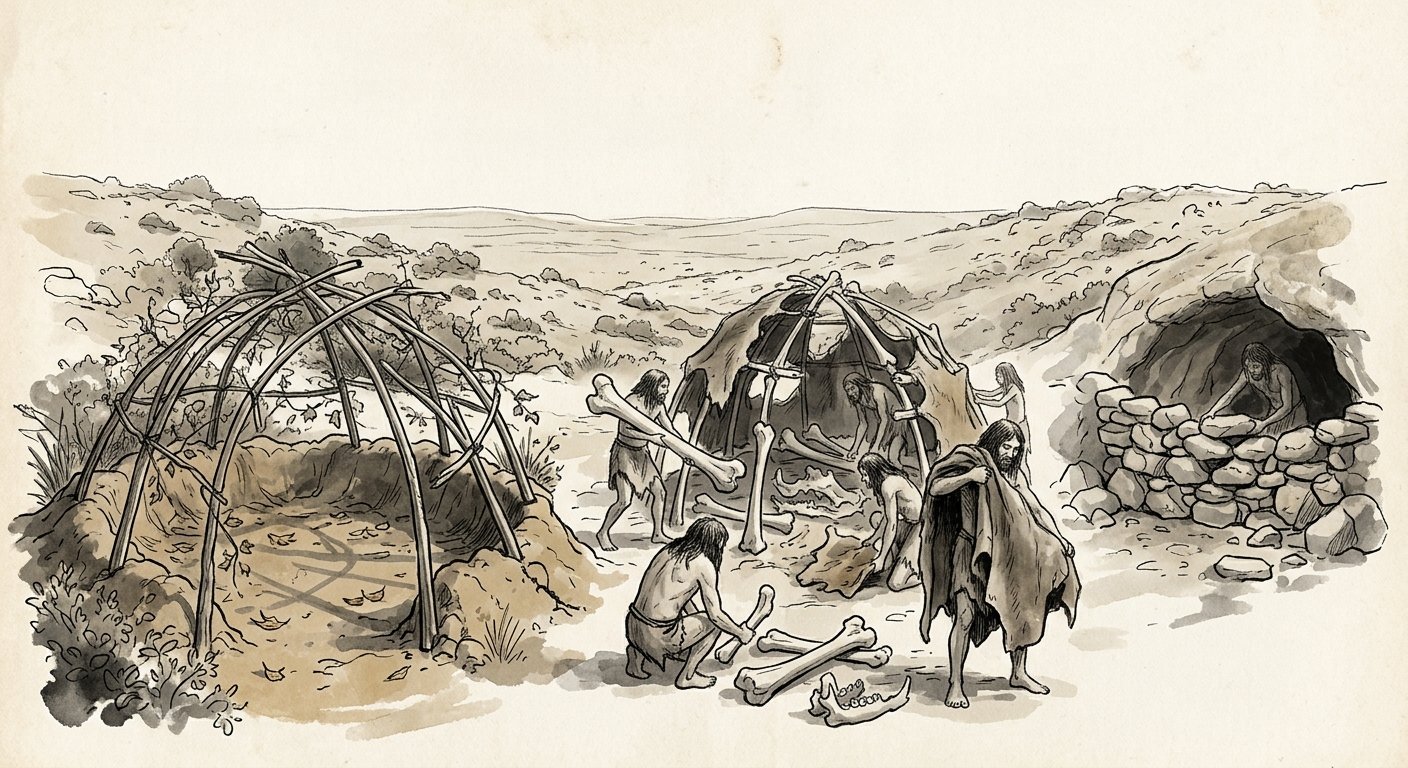
I would have liked to watch them work longer, but the place did not seem safe. I returned to the spot where I had taken the steps, but my curiosity had not subsided. That same day I made three more journeys into the past, this time to discover how nomadic tribes lived. One thing I did not expect was to discover that they also built shelters. One of them, which I found recently abandoned, consisted of mounds of earth forming a circle, into which they had driven flexible branches to create a roof. The materials were few and lightweight. There were no signs of prolonged work or of an intention for the shelter to remain there for long. When I entered it, I saw that its condition would no longer allow it to protect against the rain, although it was clear that it once had. The second structure, which I found occupied, was similar in shape and size, except that instead of branches it used animal bones and was covered with the hides of enormous animals. I happened to see the moment when they abandoned it: they removed the hides, took away the bones, and carried them with them. For a moment I doubted whether the last one was a shelter at all: it was nothing more than a pile of loose stones closing off a partially open cave. Finally, afraid that I might not be able to return and feeling quite tired, I returned to my present.
In the following days I could not stop thinking about those structures. They were very different from one another: the temporary shelters, the first sedentary hut, the house with the courtyard. And yet there was something that united them. For hundreds of thousands of years we had built with whatever we found around us: stone, earth, wood, fibers, hides. The buildings changed; they became larger, more complex, and more sophisticated, but the materials remained the same. Until, just one step before I began my journey, modern materials appeared.
Another Way of Looking
What Had Gone Unnoticed
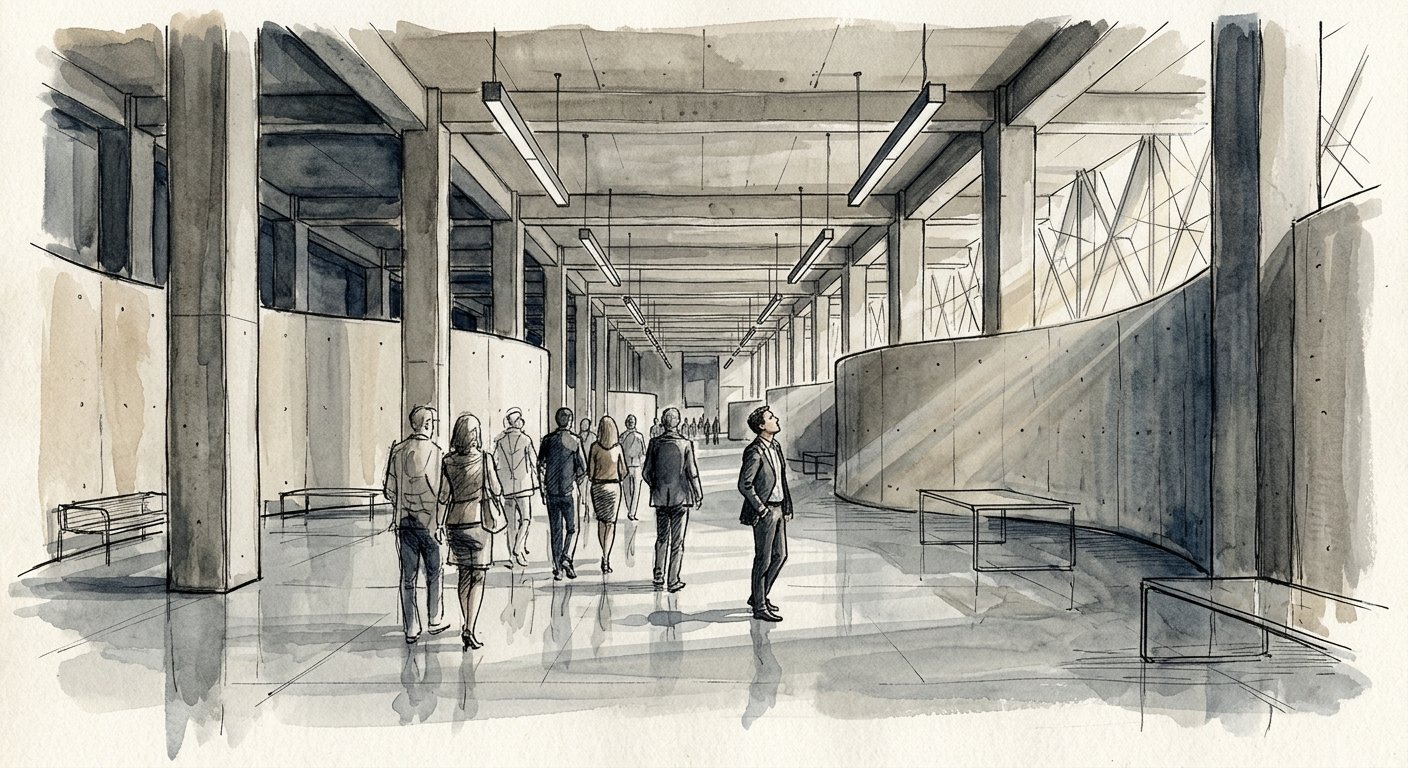
Before beginning the tour, the guide showed us the route we would follow on the orientation map. I remember paying very little attention to what the guide told us at the beginning of the tour. Instead, I focused on observing those elements of the building that seemed to go unnoticed by the rest of the group. We crossed the enormous lobby, which merged with the spaces beyond it. As I walked with the group between tall, continuous walls, I noticed that they did not reach the ceiling. This reinforced the feeling that we were still in the same space. The slab, floating above the walls, proudly displayed the concrete it was made of. Behind the walls, sturdy columns emerged, clearly responsible for supporting the slab. They formed a grid that, like the slab, made the material from which they were made evident. They were so robust that they reduced the walls to flimsy partitions. Yet the route ignored the columns and followed the randomness of the walls. It was like walking against the grain of a regularity formed by the columns, the slab, and the cold linear lamps hanging from it. Walking through the space felt like crossing a void, where sparse, light-looking industrial furniture appeared from time to time. The stone floor, gray and gleaming, almost aseptic, was in keeping with that sense of infinity. Even the light reinforced it. As the rays of sunlight passed through the geometric pattern of the façade, they merged with the artificial light until every dark corner disappeared.
Throughout the tour, the guide revealed the building's architectural innovations to us. To many, they were so abstract that they were difficult to understand. In an outdoor plaza, from which the façade and its sophisticated geometric play could be seen, the tour came to an end. As I left the building, a question came over me: Without the constant mediation of our guide, would anyone have seen the genius behind those walls?
A Familiar Taste
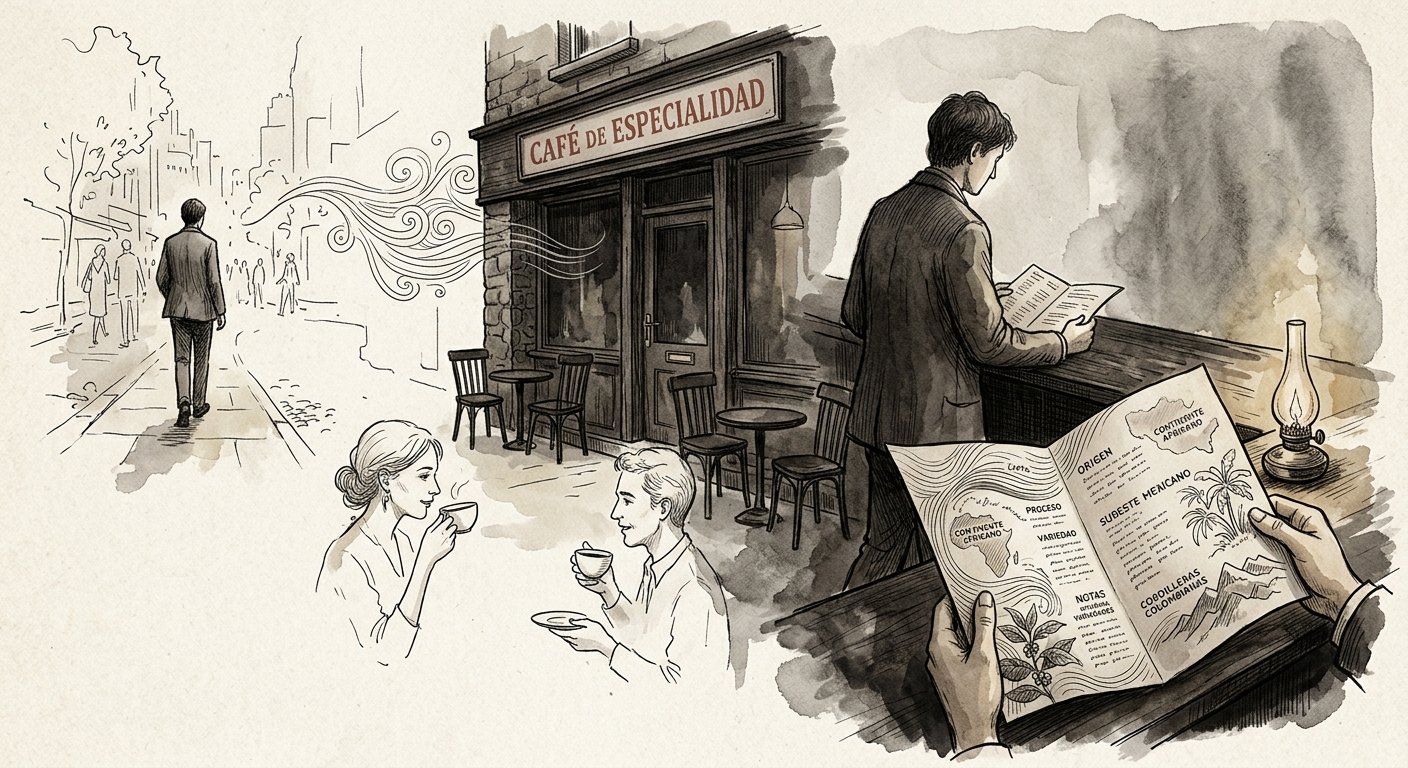
Immersed in those thoughts as I walked along the sidewalk, the aroma of coffee drifting through the air offered me a pause to think about it more calmly. It came from a small place with dark-toned finishes and chairs outside. A couple of pairs were chatting and enjoying their drinks in porcelain cups. A discreet sign on the door announced specialty coffee. That last word, specialty, did not mean much to me, but it aroused my curiosity. I went in, approached the counter, and asked for the menu. As I looked through it, I tried to find the usual options that typically include americano, cappuccino, and espresso. There was no such luck; none of them appeared. Instead, it offered options I knew very little about. Still, the attractive graphic design encouraged me to look more closely. Each option presented an origin, a process, a variety, and tasting notes. Some of the options referred to countries on the African continent. Others came from regions of southeastern Mexico or the Colombian mountains. Some had the names of varieties I had never heard of. Each option seemed to have been processed in a way suited to its qualities.
The part of the menu I understood best, and that confused me the most at the same time, was the section called tasting notes. It confused me because I did not understand what they were describing. It could have been a flavor, an aroma, a texture, or all of those things. I remember one of them precisely: an explosion of red berries, blueberries, strawberry jam, and floral notes. After reading it, I thought of everything except coffee. The other one I remember clearly said: fine dark chocolate, vanilla, subtle herbal notes, and an exceptionally silky body. This one felt closer to what I understood as coffee. After all, chocolate is also a dark beverage made from the seed of a tropical fruit. In an effort to understand what a note was, I brought to mind the descriptions used for buildings in books and museums. I thought they were simply that: metaphors that, for lack of sufficient language, tried to describe their characteristics. I would later learn something that surprised me: some of the aromatic compounds present in coffee are also found in fruits and flowers like those described in the notes.
I suppose my face reflected the intellectual effort I was making to understand the menu because, without my saying anything, the barista approached me and pointed to a sign hanging on the wall. White letters painted on it read: specialty coffee guided tasting, from bean to cup. The tasting was described as an experience that promised to immerse us in a journey designed for both the curious and the passionate. A group was waiting for it to begin. The opportunity was too good to pass up. Besides, by promising an experience rather than an explanation, the proposal coincided with what I had been thinking before entering the place. So I abandoned my initial plan of simply having an espresso.
The tasting began with what they called an olfactory awakening. We were given a short sip of mineral water and a cold infusion made from coffee cherry husks. Then small jars were passed around the table containing vanilla, cacao, dried red berries, jasmine tea bags, and others. It was a delightful exercise, although by then we were already eager to taste coffee. We did not have to wait long because at that moment they brought us cups containing three different coffees, each processed in a different way. When I tasted the first one, I asked if it contained sugar. They explained that coffee could naturally have that sensation of sweetness. The second one puzzled those of us tasting it for the first time. When I tried it, it reminded me of one of the red-berry teas they had given us to smell earlier. Without that olfactory experience, perhaps I would not have known how to describe it. The third brought a sense of relief. It was the closest to what we commonly identify as coffee, without tasting bitter.
The tasting continued with an activity in which we were asked to try two new varieties with our eyes closed. Before closing them, I was surprised by how clear the coffee looked in both cups. The first reminded me of the jasmine tea bag, and the second of something between tangerine and peach. In the final activity, we were introduced to several extraction methods, some of which I had never seen before. This was followed by a very enjoyable conversation in which we shared our experiences. I was not surprised that the favorite of most people was the one that had felt familiar to me. We highlighted its smoothness, its unmistakable coffee flavor, and the absence of that burnt bitterness so common in the coffee we are most familiar with. There were also positive comments about the one with natural sweetness. All those that I identified with fruity or floral notes were the most difficult to appreciate. We had to listen to the barista explain what made them special, although that did not turn them into our favorites. Someone commented that if we were more familiar with those notes, we would probably have appreciated them more. We were all pleased to be told that several of the qualities we had described were very similar to those perceived by professional tasters.
When I left the café, I kept thinking about that comment on familiarity. We had tasted coffees that were completely unfamiliar to us, but some had been much easier to understand than others. Not necessarily because they were better, but because we found something in them that we already knew. Then I thought about the building again. What would have happened if we had found something familiar there as well?
Without Anyone Explaining It
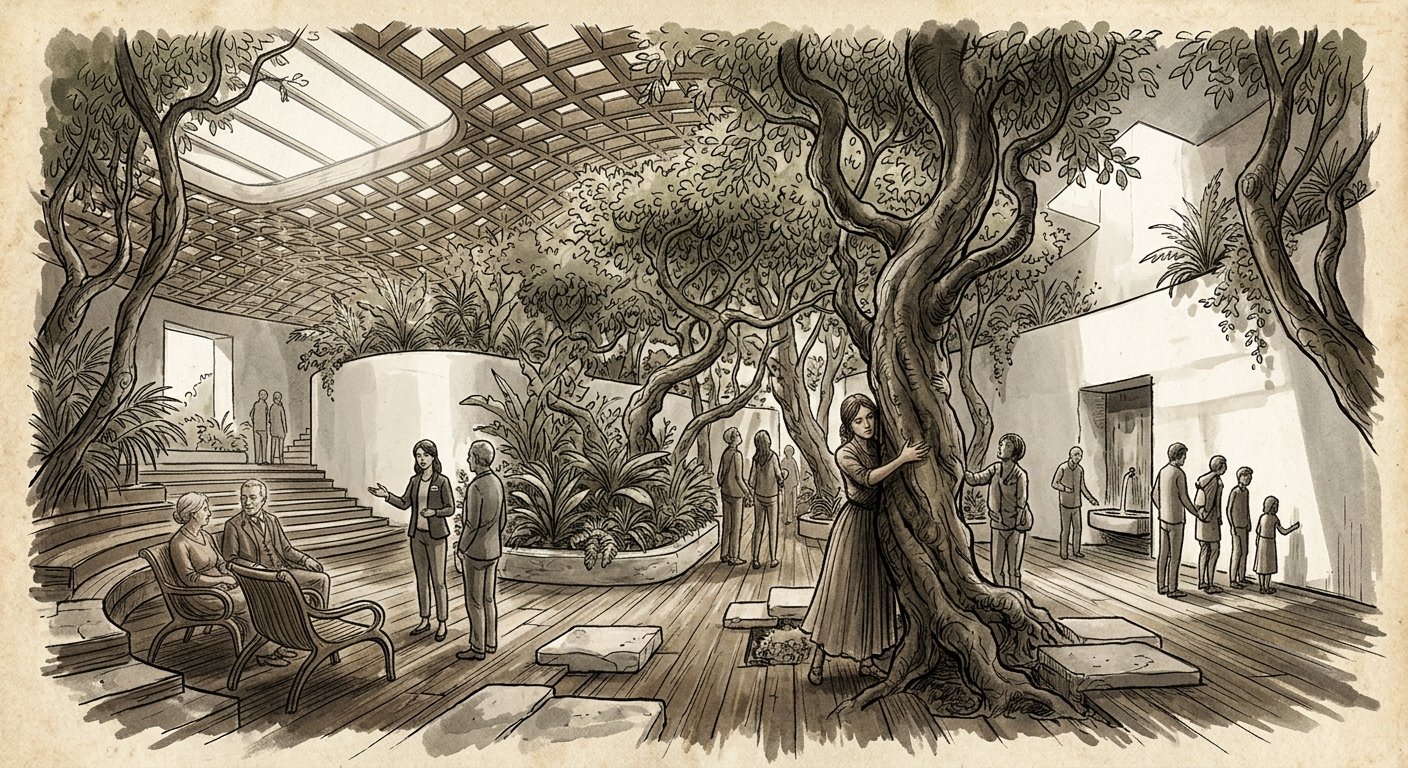
Before we entered, the guide asked us to awaken our senses and enjoy the tour. The lobby was an enormous space where vegetation and light merged. Trees rose from the floor, filling the space with an astonishing play of winding branches and green leaves. They were not alone. Lush vegetation emerged from pots and planters. It felt like walking through a jungle, but a controlled one. Above our heads, wooden beams disappeared partially into a porous roof that allowed light to pass through. The walls seemed to intrude into our path, guiding our movement; but they were discreet, always lower than and behind the trees. Although they were white, they acquired a rich tactile quality from the vegetal shadows that fell across them. Their presence balanced the material richness of the wooden floor, whose texture was so rich that more than one person ended up looking for somewhere to sit. In certain places, irregular stone blocks interrupted the floor. They had been worked in such a way that they seemed to have been brought directly from the quarry. Along the way, vigorous wooden columns appeared, almost hidden among the walls, rising all the way to the ceiling. More than one person reached out to touch them. One woman even wrapped both arms around one before moving on. Places to linger appeared as well: steps that invited us to sit like a small amphitheater, curved wooden chairs, and corners that seemed to ask for a reading break. An older couple eventually sat in one of them while the rest continued the tour. Unexpected openings created contrasts of light. Some areas received stronger light; in others, dimness prevailed. I remember some people stopping wherever the light fell most intensely, as if deliberately seeking those places. In one of these corners, we were surprised by the sound of a discreet fountain filling the space. The group stopped without anyone asking us to.
The tour was interrupted by the questions people asked the guide. But not only by that. We also stopped to look at the light, touch the materials, or listen to the sounds. Every corner seemed like a good place to take a photograph home. The guide continued walking a few steps ahead and waited for the group to catch up. Distracted by everything happening around us, few could say how many spaces we had crossed by that point. They did not seem to need anyone to explain them, nor were they in any hurry to finish the tour.